Poetry Dress-Up

I’ve been trying outfit after outfit on my newest poem in progress, and nothing works.

Advice essays by poets for poets often advocate experimenting with different poetic forms. Though free verse is incredibly popular, and is often a go-to, using a form can take  a draft in new directions. I haven’t done it very much–tried to do a pantoum with one draft, but usually blank verse is as close as I come to a form.

However, my current project has me so stuck I am desperate. So I tried doing it as a ghazal. (Basically, that’s a series of couplets that all end with the same word.) Then I tried doing a set of tanka (a five-line Japanese form with a 5-7-5-7-7 syllabic pattern.) No dice.

Experience with forms is something I’ll get more of if or when I manage to take some actual poetry classes. For now, I suppose I’ll try a couple more forms–then, perhaps, give up and put the draft aside for now. There are other fish in the somewhat murky sea of my imagination.

One-Note Solo

I wrote this on my old site Not This Song years ago–and today, I needed to read it again. I need to remind myself that it’s okay to do things badly; to be a clumsy novice. It’s even okay to do things at which I might never particularly excel. I don’t need a reason or a justification for enjoying something. Neither do you.

When I was in second grade, the school had a choir, but the teacher chose which students were allowed to sing in it. So if you didn’t have a natural ability to carry a tune at age seven, having never had any practice or instruction, you were pretty much told that singing was not for you.

When I was nine, I had one season on a girls’ softball team. Now, it’s quite true that I sucked at softball. I was afraid of the ball; I was uncoordinated, and–something we didn’t know then–I couldn’t see worth a damn. This interfered with batting and catching. So softball wasn’t for me at that time…fine. But was it really necessary for the adults to shake their heads and conclude that I was never going to be athletic? It quite literally took decades for me to realize that, with my adult body, I’m not completely lacking in physical gifts.

When I was twelve, I got an F in art. Seriously? Who gives a kid an F in art? I don’t have a problem admitting that my clay dragon sculpture looked more like a dragon turd. I have a problem with being labeled “bad at art” and living in a culture where that meant I wasn’t supposed to do art any more.

I know, my story’s not unique. What matters is what I do about it now. Starting to write is a big part of this: I’m defying the messages that tell me writing is restricted to an elite class, or that it’s only worth doing if it will be well received. The bad poetry thing is another example. I also have aspirations toward becoming a bad artist someday.

There’s one area where I really made progress as an adult, and that’s singing. Thanks to the urging of a friend, I joined a choir with him in freshman year of college. It turned into many years of singing with various amateur groups. I finally got the experience of being new at something, doing it just well enough to get by at first, and gaining in ability and confidence as I got more practice. That concept we call…what was it…learning?

The best choir director I ever knew once said to us: “Don’t sing tentatively. I’d rather have you all slam into an entrance in the wrong place than do the entrance half-assed.” He meant it, too.

One day we were doing a full orchestra rehearsal, and the soprano entrance was a fortissimo (very loud) high G. When you’re a soprano, there’s one thing you learn about hitting those high notes: whatever the volume, full commitment is necessary. If you sing it any other way it will come out flat. The only way to sing it right is to be willing to risk singing it wrong.

It was probably one of the nicest G’s I’ve ever sung. It rang clear and bright, with a crisp start and plenty of feeling behind it.
Too bad it was one measure early.
I blushed bright red as the conductor prepared to start us all again, but I was able to join in the good-natured laughter and smile sheepishly when the director complimented me on my one-note solo.

Thanks, Maestro, for meaning what you said. That errant note made thousands of great notes possible.

The Other Shoe

I’ve been doing something dangerous recently: taking better care of myself.

After a very long downward spiral of diabetes/low thyroid/weight gain/depression feedback loop fun, things have begun to move in the other direction since spring. It began with a desperate, no-holds-barred attempt to bring my blood sugars under control with a change in eating–a change that, surprisingly, worked well. It accelerated when this change, somehow immune to my eating/weight baggage because it was serving the blood glucose meter and not the scale, began to have the side effect of taking off a little weight. It accelerated more when something about what I was doing affected my thyroid and my levels approached normal for the first time in years. My most recent labs are a thing of beauty compared to the values of last year.

So why is this a dangerous thing?

It feels dangerous because a part of my psyche is convinced good things won’t stay. A lot’s been written about the psychology of growing up in a household of substance abuse and/or violence, but you have to be one of us to know the sickening plunge of fear that comes when the unpredictable trouble erupts. Everything seems all right, then the floor drops out from under you and you’re in fight/flight/freeze mode. And because you’re a kid, sometimes the third one is the only available option.

Anyway, that part tends to make itself heard when things are going well. I have an inner conviction that something awful is about to happen, and when something bad does happen it’s taken as a confirmation that I was right.

The more I feel a sense of hope about the improvements in my health, the more convinced I am that some terrible punishment awaits. The resistance I battle every time I write something or do anything else positive is almost palpable. It fuels itself with everything from little symptoms to relatives’ ailments to the news:  “You, or someone you love, or the planet, is going to pay a price for your selfish behavior. It’s only a matter of time.”

The Fiftieth Person

Once, while preparing to speak at a recovery event, I wrote something like, “Open my heart, and then open my mouth. Let me look like a fool to forty-nine people if it will help the fiftieth person.”

Do I have the courage to apply that idea to poetry as well?

In a couple of days I’m going to read a few pieces of poetry at a recovery event. The audience will be very different from the ones I have faced before–for the first time,  I’ll be reading poetry to an audience of people who may have come for other things and have no interest in the poetry part of the show.  I’m experiencing a much higher level of public speaking anxiety than what is normal for me. I’m trying to revamp some poems into a format that I think is “cooler” or more likely to go over well–and the revamping is at a complete stall.

Not too surprising, I suppose. While my self-care has had some improvements lately, I have been very blocked when it comes to writing. The reasons are both repetitive and unoriginal, but there it is.

At any rate, past experiences give me faith that when the time comes, I will step onto the stage and manage to read. Past experiences assure me that this will happen, and the world will not come to an end. I just have to show up.

Too Little, Too Late

The phrase haunts me. Whenever I find a lump where a lump shouldn’t be, or even have a twinge of pain in an unfamiliar place, the fear comes up. I’m turning into a hypochondriac, and I don’t like it.

It’s not just that I am afraid of dying, although I am. It’s that part of me is still waiting for a judgment from the universe–a judgment saying I’ve had enough second chances. A judgment saying my current efforts are too little, too late.

I recently spent time with a fellow addict who is on dialysis. For three years, she tried to quit smoking in order to get on the list for a kidney transplant and could not do it. She finally succeeded—two months before a heart complication showed up and derailed the whole process. Too little, too late.

My blood sugars are lower than they’ve been in a long time–but with every exam I fear the onset of some complication born during the less controlled times. My weight is improving slowly from the place it reached last year–but with every sore knee or backache I fear that I’ll never dance again.

It all feeds into the roar from the ever-present peanut gallery that observes my efforts at writing: You’re too old! It’s too late! There’s not enough time left to accomplish anything that is worth doing!

Starburst

I now have THREE poems stuck in pre-draft limbo. One has been there for two days, one for two weeks, and one for at least a month. What is this thing in me that will not give me permission to sit down and hammer out a first draft?

Well, besides mental health issues and a lifetime of experience at self-sabotage.

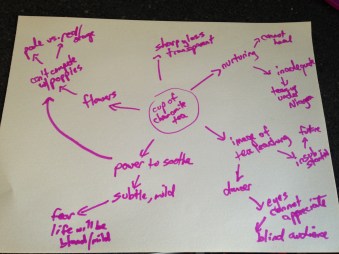
In desperation, I did a starburst on one of them. It looked like this:

FullSizeRender

The starburst is a brainstorming technique. You put a single image or word in the middle and start drawing associations; some will be important and some not.

My image for this poem has been clear from the beginning: a glass mug of hot water with a chamomile tea bag in it. Pale brown-gold threads are drifting out into the water as the tea starts to be absorbed.

The image, like many of those a poet chooses, is a tool for crystallizing a moment and the thoughts and feelings that went with it. The starburst helps me elucidate some of those.

I’d like to say that the starburst promptly galvanized me into action–well, not yet. But I know I’m closer, both because of such things and from having coffee with a fellow poet yesterday.

Fear Not?

I chose today’s piece because fear has been clamping down on my creativity lately. Just like any other emotional state, fear comes in both useful and useless varieties when it comes to writing–with the useless kind, my brain freezes or flees into escapist behaviors. So…

(Originally posted on my old page Not This Song, 2015)

How much does fear rule your life?

Those who do some kind of deep self-examination are often surprised to see how deeply, widely, and diversely fear is imbedded in their psyche. I don’t think I was surprised to find its presence in some deep places, but it was enlightening to see how much of my daily behavior is fueled by it on some level.

It’s hard to admit how afraid I am. It’s easy to buy into the idea of courage and strength being incompatible with the presence of great fear. It’s easy to forget how different we are from one another sometimes; that something only mildly frightening to one person may be a source of utter terror to someone else.

There’s an old story about two soldiers in a trench during World War I, waiting through the tense hours before a charge. One sits calmly, while the other paces incessantly, chain-smoking and talking nonstop. The calm one makes a disparaging remark about his nervous comrade, and the other replies: “My friend, if you were as afraid as I am, you would have run away a long time ago.”

I am afraid the way that soldier is. Too afraid to pretend not to be, too afraid to carry things off with style. I need to comfort myself with stories like this, becasue when I scratch the surface of my skin hard enough to penetrate the thin layers of maturity and faith I find a sea of fear. I think I need a hundred words for the many different varieties of fear, with their subtle shadings of meaning and manifestation.

If you’ve ever been afraid the way I am, you know that it doesn’t respond to logic. Oh, some fears do, or they can be soothed with emotional support, or by questioning them with cognitive-behavioral techniques. But there are kinds of fear so primitive, so nonverbal, so far beyond any mental construct that our attempts to soothe them feel like trying to send a T-rex to therapy.

One kind is what psychologists call “annihilation anxiety.” It’s what it sounds like: fear of utter destruction, unmaking, nothingness. Its roots lie very early in life–in the stage of complete dependence of an adult figure and the terror that losing said figure’s love would mean destruction–and it’s nonverbal and primal enough that sometimes I don’t even realize it’s come up until I’ve been reacting to it for days.

Primal fear comes up in our old baggage and in new baggage that got influenced by the old. It’s what is operating when we do things in our relationships that just don’t make sense; when our therapist and friends and whoever have a clear, obvious idea what should be done, who should be confronted, who should be left, but the thought of actually doing it is–well–unthinkable.

What to do about it? Oh, you already know what I’m going to say. There is no swift and logical cure for this kind of fear. There’s no cure at all–only the chance to go into remission. To fight the fear to a standstill and wait for it to get tired and take a break. But how to fight something you can’t see, or speak to, or argue with? Can a sword cut darkness?

No, it can’t. Nor can clever words convince it to retreat. There are only two things I can do: first, stop acting out in a futile attempt to drown the fear under more familiar pain. Then huddle close to the fire. Feed the fire, watch the fire, and don’t let it go out, and try not to think too hard about what will happen if it does. Feed the fire of my Self; yes, and the Self, whatever mystic force that is. Everything I am that is not nothingness. Everything I am, and was, and will be, that is the opposite of nothingness.

I’d Rather Kill An Antelope

(Originally posted on my old site Not This Song, 2013)

For a long time, I tried to pass for normal. By normal I mean my idea of what my normal should be, which many would call overachieving. I was gifted with some abilities and I had certain expectations about how they should be used. When I failed, or had a breakdown, or acted out with food or drugs to drown my symptoms or stifle the disconnect I felt from myself, I told myself that I would straighten out my problems and then I’d be able to succeed.

Eventually, over a period of years, I came to know and even to accept that there were some things about me that meant I needed to change my expectations. Part of it was accepting my mental health issues; part of it was just understanding my personality better. I tried to set new goals more tailored to my real self.

I’ll do or think just about anything to have a shot at feeling good about myself. On a very deep level, I believe I have to do or be something in particular to have earned a spot in this universe, and I try to convince myself that this is indeed happening. So, when I began to accept my differences, I tried to convince myself that those differences made me special. When I felt envy toward other mothers with clean houses and more organized lives, I dealt with my feelings of shame by embracing a sort of eccentric genius identity; someone above or beyond such mundane concerns. When I felt envy toward my former classmates who had great careers, I told myself that their lives must not be as psychically or spiritually rich as mine.

There’s nothing wrong with believing that I have something to offer because of and not just despite my differences. But it’s not right for me to use that idea to gloss over my responsibility to try to learn to cope with “normal” life as well as I can. It’s also not right for me to use this “weird equals special” idea to cover up the very real pain I have about the things I will always struggle with.

The truth is that there’s a part of me that will always long to be a relatively normal, functional person. The psychologist Marie-Louise Von Franz, one of Jung’s early students, wrote that in ancient tribes the boys who ended up being shamans were usually unsuited to be hunters. Many of them would have rather been a hunter; would rather have been the hero who brought down the biggest antelope at the hunt. The young man who stood proudly at the initiation rite, being welcomed into the ranks of adults and feeling the satisfaction of having provided a meal for the hungry. The guy who married the prettiest girl in the tribe, had eight children and became a respected elder. They’d rather have been that guy than the guy living in the isolated cave, playing with bones and having his entrails metaphysically scattered by jackals.

Even if I join the writers and poets and the other shamans of our time, there will always be a part of me that is sad not to be a hunter. That envies my husband’s ability to function at a corporate job without having to take anxiety attack restroom breaks every hour; that cringes in shame when I read about friends who are working for social justice. I am learning to function better, and I have hopes about being able to help and serve others better, especially the dual diagnosis community. But I feel like a shaman on a hunt: I might learn to hit a squirrel with my slingshot, but the antelopes are for the real hunters.

I know that being the shaman had many compensations, and I’ve tasted some of the wonders and beauties that may enter my life more and more. I might become a good shaman. I might serve the minds and souls of others. I even hope to become a voice that will help bridge the gaps in understanding between groups of people. But it’s important to admit that I wish I could also be a hunter; that I cry when I think about the problems in the world and all the work that needs to be done. My people are hungry; the shaman cries: they don’t care where my soul is traveling tonight. They just want to eat, and neither my passion nor my tears can feed them.

Laureate

Last night I went to a reading by California’s current Poet Laureate, Dana Giola. It was interesting to hear from someone who has had such a long and varied career–he’s a former chair of the National Endowment for the Arts, with an MBA and a PhD in literature. He has taught and promoted poetry education all over the state for years.

The contrast between seeing his poetry-as-my-career persona and the more intimate experience of hearing his poetry was fascinating. He, like many poets, writes of love, grief, communion with nature, and all of his human experiences. However polished and goal-oriented he may be in his endeavors, when it comes to his poems he is naked. And thank the gods for it–how else could I feel connected to him and keep any feelings of envy and inadequacy to a minimum?

Because (and this will be no shock to those who have read any of my writing) I do have these feelings. A career such as his is not achievable for me unless I invent a time machine and manage to get started writing well before my late forties. I must focus on what I can do in the time I have, and I must keep my eye on that which makes me want to write whether it leads anywhere or not.

Oak Tree Debate

Have you ever written a story specifically to help you with a poem? I have a poem that’s been incubating for a couple of months now. Like many, it started from an image and a thought, but it will not coalesce into a phrase that serves as a “hook” for the poem I want. So, as I talked about recently, I’ll write about this as prose and see if that begins to help the process.

The time: May, 2011. The place: a residential drug rehab center in Northern California.

The center was set in a lovely area, surrounded with picturesque roads (and, ironically enough, wineries.) The buildings of the center housed about forty addicts in various stages of detox and early recovery.

Once you were deemed past the worst early detox symptoms, you were allowed to leave the house and walk about the grounds. There was an open area, away from the main compound, with a single bench. The bench faced the largest oak tree I had ever seen in person. It was the only tree in the field, and seemed sentient when you looked at it long enough.

People were encouraged to spend time there, thinking deep thoughts. I didn’t need encouragement; it was a pleasure to get away from people for a little while.

So that’s the image: a huge oak tree, spreading its old and complex branch systems against the sky. The pattern of branches seen against morning sky, and midday sky, and evening sky.

Some people might have used the place for meditation, and some for prayer. I sucked at meditation, and while I had nothing against prayer I couldn’t concentrate on that either. My mind was occupied, more often than not, with what I later came to call the Oak Tree Debate.

The subject of the debate was simple: Did I want to live? And, even if I did, did I deserve to live?

The oak tree, it seemed to me, was my judge. It was the embodiment of all that was natural and true, while my drug-tainted, mentally ill and self-destructive presence felt like the embodiment of all that was not.

Even the bench I sat on felt soaked with pain and toxicity. I thought about all the addicts who had sat there for decades before me. Ashamed, grieving, belligerent or hopeless. I thought about how many came back to the bench more than once, having relapsed after weeks or months or years. I thought about what the oak tree might think of them, and of me.

The trouble with presenting a case to my arboreal judge was twofold: I was not competent to be the best advocate for myself at the time, and I did not speak the oak’s language. My case was inconsistent at best, and even if the oak did render a verdict I could not be certain of what it was.

In the end, I had to go from that place without a clear conclusion to the debate. It has continued, off and on, through years of recovery and treatment for my mental health issues. Perhaps it will never end–but when I can, I choose to imagine a verdict that tells me to keep going.

Just As I Am

Today I’m wrestling with a common question: go to a poetry reading or not? One of my favorite monthly ones is happening this afternoon, and I want to go–but I’m not having a good day.

Not having a good day, in this case, refers to my bipolar symptoms. The depression and disorientation are up for me right now, and it is hard to focus. When I am like this, I feel a bit alien and more socially awkward than usual. How much of this is my perception and how much actually affects others is hard to determine.

Would going to the reading do me good? Yes, almost certainly. It’s an opportunity to connect with the poet I am and disconnect from mundane worries.

So what’s trying to keep me away? Ego, of course. Not wanting to show my vulnerability. Wanting people to like me.

Let’s break it down, however. Some of my poems that touch people the most are my most unguarded ones; the ones that expose me. One of my favorite things to say to myself when I am blocked is “When all else fails, tell the truth.”

I’ve written it before, but for me it bears writing again: my best qualities come forth when I offer myself to the world, just as I am, and let others decide what to make of it.

Are We Disposable?

(Originally posted on my old page Not This Song, 2014)

It’s a selfish question that hovers around the edges of my mind when I think about the state of our world. I’m not involved in politics, and I tend to be ignorant of many topics that speak of important developments–I don’t like that about myself, but it is my truth. As my readers know, there are times when my main contribution to society involves working on ways not to be an active drain on it.

Those who share some of my issues are often seen as an impediment to the prosperity of others, and certain voices try to shame us when we use the services our governments may provide to care for those who have trouble caring for themselves. I’d like that to be different, but I don’t imagine it will ever be uncomplicated.

In the end, we are all still animals competing for resources, and only the trappings of civilization introduce the idea of giving any resources to the helpless. Some have said that the measure of a civilization’s advancement is related to how much, and how well, they care for their children, their sick and their elderly.

Whatever one thinks about the world situation, it’s pretty clear that overpopulation will continue to be a problem. Resources will be at more of a premium, and there will begin to be more sorting of which kinds of sick or disabled are worthy of help. Mental health may not be highest on the list. Addiction-related issues are likely to be even lower, since addicts are usually seen as deserving their suffering.

This, from a Darwinistic point of view, may be a regrettable but unavoidable thing. But how much should we resist its progress? How much should we fight to be seen as something besides a liability? Is there a place for us in the future?

Sometimes, when my mind is spinning its catastrophic phantasies, I go postapocalyptic and imagine how long I, and many I care about, would last. I always imagine myself as a liability to whatever group I’m with, unable to function very well without my meds, or unable to see because my glasses got broken. I see myself as useless, without a lot of physical strength or swiftness to build or get things the group needs. I see myself as the first to fall behind and become lunch for zombies–unless a friend gives me a helping hand.

And why should they?

Why should they, unless we have some kind of value that isn’t strictly practical?

Why should they, unless those crowded barracks or underground warrens need us? Unless humanity is incomplete without us? Unless there’s a spark that’s worth maintaining, a spark worth a bit of food or a place near the fire?

Why should any society help its disabled, even when a cold equation might say the help isn’t bringing a sufficient return?

I got on this subject with my therapist during one of my dark and hopeless spirals recently, and we talked about the idea that humanity, by nature, will always need its shamans, its poets and its weird people in general, as well as the wisdom of its elders. “That may be true,” I said, “but you can’t deny that in a crisis state the strong and able will be valued most. The women who can bear healthy children, the physically strong, the mentally stable: these are the ones who can outrun the zombies or will get rescued first. You can’t deny that I’ll be one of the first to go.”

Then he told me that, although it might be true in some situations, it doesn’t mean I deserve it. Then he said something that cheered me up: he told me that if it does happen, maybe I’ll discover that the zombies are in need of poets too. Feeling better, I began to imagine my new dream job as Poet Laureate of a zombie city.

I don’t know if we are disposable. I don’t know, not for sure, whether our existence has intrinsic value. But I do exist, and I am grateful for it, and I have a daughter for whom I want to model values of love and not shame. I want her to see me doing my best, and believing I have something to give the world, so that she might learn to believe the same thing.

So I send love to all my peers, and invite us to go down swinging if the time comes, and hold our heads up until then. As a token of my affection, I enclose the opening poem from my potential future body of work:

Brains

Arrrgh brains brains
Brains gurgle thud howl
Brains brains crunch splat
Brains brains brains.
Shapeshifting

What form does the piece of creative writing you’re incubating want to take?

I’m beginning to understand why so many poetry exercises want you to tear apart a poem and experiment with writing it in different forms.

I already knew that changing the voice of a poem can be a powerful tool–if it feels awkward in the first person, try third or second, etc. I already knew that trying out a specific form like a pantoum or sonnet can be a fun way to experiment with one.

What’s really making me see it, however, is comparing works of mine that deal with the same idea or image in prose versus poetry. As I go through old essays, some of them cry out to be used in a poem. At least one of them already has been.

I realize that when an idea or image is potent enough for me, it could give birth to several pieces, each in a different form, each powerful in a unique way.

Knowing this helps me feel more cheerful about revision…the old saying that “a poem is never done” brings a sense of hope and mystery rather than paralysis.

Estimable

(Originally published on Not This Song, 2013)

The good news is that I’m dressed and I’m wearing shoes. I took my vitamins, ate what I’m supposed to and I’m ready to tackle the rest of the day. The bad news is that it’s 1:47 p.m. where I am.

What is success, and who decides the difference between success and failure? I’ve had to change my ideas about it several times, because the alternative is self-loathing and despair. I’m honestly able to give myself credit for the good things I manage to do, and the harmful things I manage to refrain from doing. Sometimes. I compare myself to other people less often and less harshly than I used to. Sometimes.

I’m honestly pleased with myself for getting through my latest severely anxious phase. I’m pleased because I didn’t lose sight of the big picture and I didn’t do a lot of things to make it worse.

An accomplishment–but not the kind I can put down on a resume. Not the kind that makes good party conversation. Not the kind that comforts me a lot when I hear about friends and former classmates who are doing things…who are having accomplishments that can be listed and quantified.  During college, and later, I got to know some people who forged on and now do some pretty neat things. One works for NASA. A few others are scientists doing research with major institutes. Several are kick-ass teachers helping the next generation have a chance to learn. One’s an amazing minister and social justice advocate.

One of my biggest regrets about the last ten or twelve years is that I drifted further apart from many of these people. Inertia and laziness played a role, but most of it was my own insecurity, because I thought of them often. I never knew what to say when people asked me how I was doing, and I hated the idea of being seen as the “one who had so much potential.” I convinced myself that I had little to offer, and that they were too busy with their important and successful lives.

I was wrong. I lost touch with our shared essential humanity…I objectified them by forgetting that they have their struggles too, and I didn’t have the courage and humility to keep offering myself and let them decide what they wanted. As I grow, I hope to work on this…I don’t expect to be able to repair all of these relationships, but I want to become the kind of person who does things to show I’m thinking of them and I care.

This means I have to continue to work on my own insecurity, and learn to view myself as having something to offer even though it’s something different. It’s back to evolving a standard of success for myself, one that fits with who I am, what I have to work with and what I believe. One that will inspire and drive me, but not be used as a tool for self-shaming.

The psychologist Karen Horney once said “If you want self-esteem, engage in estimable behavior.” I love that quote because it makes it clear that building a good view of self isn’t about rubber-stamping all of my flaws…I don’t want to feel great about myself when I sit on the couch and do nothing. Compassionate, maybe, but not admiring or self-satisfied. The way to feel better about myself is to get up from that couch and do something, anything, that fits with my values.

Karen Horney didn’t define what “estimable behavior” is, that’s for me to do. If I’m in a crippling depression, I have to accept that dragging myself outside or to a meeting qualifies. If I’m having an anxiety attack, I need to give myself some credit for writing about it, and cutting out collage pictures to occupy my hands, and being honest while it was going on. All of the things I am doing that are out of my comfort zone are estimable in their own way, if I can avoid comparing them with someone else’s version.

This is my fifty-third post on Not This Song. That means that in the last three months I’ve written more than fifty essays. Created fifty things that didn’t exist before. Opened up fifty times about some idea that has meaning for me. Would anyone care to guess how many pieces I wrote in the previous five years? That’s right. Zero.

I will be proud of this.
I will learn to admire the accomplishments of others without turning them into a condemnation of my own.
I will allow my essential self to purge the poisons of envy and shame from me.
I will.
Even if it takes more than one lifetime, there’s no better time to begin.

Beginning the Process

So, I just did the first cross-post from my other site. There will be many in the upcoming weeks. I picked an old post for the first one, but they won’t be in any particular order from now on.

I won’t be transferring everything. Some old essays feel less relevant because they talk about very specific things that were going on at the time. Some may also be edited a bit. But I want to preserve my favorites.

That being said, I also want to have plenty of new posts about what is going on with me now. How the poetry readings are going, what new submissions I am doing, and how I continue to navigate the journey to a more creative life and deal with the roadblocks that appear.

Today I’m heading to a poetry reading in Benicia, CA. I’ve been to it before, and it’s a mellow atmosphere. Familiar readings are nice; I get more comfortable with repetition and more willing to share brand new and less polished works.

Talking to Seagulls

Originally posted on Not This Song, 2013

Today I had the privilege of going on a trip to the beach with my daughter. Yes, I engaged in a mundane, family-oriented, pleasant activity that many people see as a very normal thing. I do not, because for me it is anything but mundane. I don’t take things like this for granted. For example, being near the ocean today reminded me of a very different day near the ocean, and this is the story I will tell.

It was one of those days. THOSE days. There was a thick gray veil between me and the world, and my thoughts moved sluggishly but malevolently beneath a matching oil slick on the surface of my mind. I was on a medication merry-go-round, with well-meaning professionals trying to find the right chemical to help stabilize my brain chemistry. Every new attempt brought a set of nasty side effects, and I was urged to be patient for at least eight weeks to see if the medicine would have a therapeutic effect. When the side effects altered my mood enough to be dangerous, the doctor would add something else to the mix to try to combat this.

At this point I felt the way my poor dolls must have felt when I cut their hair as a child: it turned out a little uneven, so I would cut more to fix that, then more when it was still uneven. I can still see their traumatized little doll faces under a few uneven hanks or hair clinging to their holey little doll scalps.

When my family suggested a drive to the beach, I didn’t want to go. After all, I had planned to spend some quality time in the fetal position. But I knew from experience that being outdoors was good for my mental state, and I was lured by the tactile pleasures to be found at the beach. I knew I could sit and run my hands through cool, wet sand, again and again, reducing the gray whirl in my head.

So that’s what I did, after my husband and daughter parked me in a congenial spot and wandered closer to the surf. I’m sure it was a relief for them to know I was peacefully occupied, because being on an outing with me in this state is like carrying a balloon: the balloon isn’t really contributing to the conversation or the activities, but you have to hold on to the string all the time or it will drift away.

As I raked through the cool sand, the breeze seemed to wake me up and I began to feel more anxious. A seagull alighted on a nearby mound of sand and I talked earnestly to it, talked about how I was feeling and how frustrating it was to be in my head. The seagull was a good therapist, I suppose, but a little old school for my tastes. I like a little more feedback, or at least some attention to the relationship.

I needed more. So when the family came back I told them I wanted to go for a walk alone. I was too tired and weak to go far, but I found a rock to sit on and watch the waves. It hurt so much to see so much beauty around me and yet not see it, to feel so many sensations and yet not feel them. I decided I should try to pray. I believed in Something, but I always felt stupid trying to talk to it. I don’t remember what I said, but I felt as awkward as usual. I thought maybe my God would send me some kind of sign, that an eagle would swoop across my vision or a rainbow would flash from the spray of a wave at a dramatic moment. I was ready to take something like that as a sign that I should hold on; a sign that there was a plan and things would get better. Nothing happened.

I felt my energy draining away again, and I was about to get up and make my way back toward the car when an impulse made me take one more deep, deep breath of salt air. Looking one more time at the rocks and waves, I said one last sentence to my God–the God who doesn’t fit any one religion, the God I was not at all convinced could help me with anything. I said “Well, I won’t give up if you won’t.”

Feel free to roll your eyes at this point in my story, because I did see something then. Not a bird or a rainbow from above the water, but a wet, brown head popping into view from below it. A sea lion, so close I could count his whiskers. I’d never been so close to one before. He or she swam toward me, rolled in the water a couple of times and was gone below the surface again.

This is the part where I tell you that this was the turning point for me; that I was never that low again, that the little sea lion was a messenger of hope and meaning that has never left me. But none of that would be true, and if you share some common ground with me your life probably doesn’t work that way either. Things did get better for me, but not right away. And later they got worse again. And worse still. And then better. You get the idea.

It was a moment, that’s what it was. A lovely, funny moment like a cherry in a bowl of gruel. It’s stuck with me because it was the first time I prayed in a way that portrayed me and my God as a team. It’s stuck with me because I love the ocean and I feel so much gratitude for a day like today when I can really see it. I drove us to the beach today, and I walked several miles along the shore. Nobody had to hold my string. I can’t expect that it will always be this way, but I can appreciate the moments. We all can.

Joining

I’ve been thinking about my two websites lately. The first one created, Not This Song, was focused on my experiences of living with bipolar disorder and living in recovery from my addiction to painkillers. It ranges far afield in topics and uses metaphors from just about anything. This site was created later, to focus on my poetry and my experiences with writing and creativity.

At the time, the distinction made sense. Lately, however, I have been struggling with writing frequently enough on either blog. I’ll want to write, then get stuck about which site to update with those words–and the thought of updating both seems like too much when I am feeling overwhelmed.

Life and art are blending together, and it is harder and harder for me to separate them. I have decided to join them together, making Not My Last Words my only site. I’ll still write about a wide range of topics, but most of the time they will be linked to some aspect of my creative work (or lack thereof.)

Over the next couple of months, I will cross-post my favorite things from the Not This Song archives so that they will exist in the archives here.

If you are a poet who has found this site, I hope the other topics won’t bore you. I hope to create a site that speaks of one person’s creative efforts and progress in such a way that others can identify.

Mentioned

img_1701

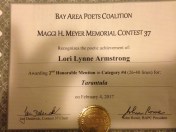
My first poetry award! I received a Second Honorable Mention in an annual Bay Area poetry contest. At their monthly get-together, I read my poem along with many other winners (there were four categories) and got to hear theirs.

The little kid in me is very excited about this. When I enter a contest or send off a submission, I look at it as gathering experience. I’m still so new to sharing my poetry that I need experience to become comfortable with the process. But I’d be lying if I said getting some recognition isn’t fun. This comes on the heels of doing that small feature, which was also an honor.

Here’s what I want to say to poets who haven’t yet read their work in public: TRY IT!

I first read poems in public on June 4, 2016. That’s less than nine months ago.

Cards

The reading was an amazing experience. My concern that the audience would be small proved to be correct, but that’s really the only thing I would change. The longer time allowed me to get into more of a groove, and doing so allowed me to read a couple of poems I wouldn’t feel comfortable reading at a two-minute open mic. They went over very well.

Because I had no books or chapbooks to offer, I thought I should at least have some cards to give out. So I went and had some inexpensive ones made at Staples. Let me tell you, designing it was a bit of a mental hokey-pokey.

I’ve had business cards when working in biotech. I’ve had them when I was working as a counselor. This is the first card I have had that describes me as a poet and writer. What should it say?

In the end I went with my name, the names of my two websites, my contact info and my unofficial motto of  “One Metaphor at a Time.”

Giving them out to people felt very strange, especially the idea that people who know me only by my poetry will know a great deal more about me if they choose to visit the websites.

I tell myself that’s OK. I write my best when I am my most authentic, even if that means I am authentically broken.

Peanut Gallery

My feature reading is tomorrow night. I’ve enjoyed preparing for it. I have also spent some quality time listening to the peanut gallery of my insecurities. Twenty-five minutes seems like a long time, although I know from other public speaking experience that it will probably fly by.

Beyond the normal insecurities one might have about public speaking, however, are a set of insecurities more specific to the type of sharing I’ll be doing. Here, in the spirit of putting honesty before pride, are some of them:

–I arrive and find that the audience is a fraction of its usual size because of the inauguration and the protest marches. This one has some practical basis, but there’s nothing I can do about it. It will be what it is.

–The audience, of whatever size, is disappointed that only a small amount of my poetry immediately relates to current events. They judge my work as self-involved and frivolous.

–The audience is baffled by the wide range of topics my poetry spans. They judge me to be without a unifying vision.

–The audience discounts anything I have to say because I am at the higher end of my weight range and don’t fit their picture of what a poet looks like.

–The audience sneers at the hints of spirituality present in some of my poems. I am written off as a kook rather than a serious poet.

–The audience is repulsed by the personal things they learn about me through hearing a wider variety of my work, and their view of me is now altered by prejudice and misconception.

There is a sample. The thoughts range from reasonable to ridiculous, but they are mine and deserve acknowledgement. Here’s the good news, though–I have faith that none of these insecurities are going to stop me from enjoying myself. I have another persona that emerges at times like this. It’s authentic, but is somehow able to place hesitation aside. The insecurities will probably come back when I’m done…but when I’m up there, it’s going to feel amazing.

An Honest Poet

As I approach my first experience of featuring at a reading, I need to remember the importance of honesty. To be an honest poet is to present myself and my poems in a way that reflects who I really am as a poet, not what I think my audience might admire the most.

I’ve noticed that I am nervous about my reading taking place the Monday after the presidential inauguration. Emotions may be running high, and it is not unlikely that the open mic will reflect this. My insecurity tells me that I should try to generate some work that would address current events.

I worry that people won’t want to hear a bunch of work that has nothing to do with any of the topics so present in our minds and hearts right now. But that’s not for me to decide: I think being asked to feature means being asked to let people see a broader picture of my work. Presenting a hurried and forced set of work, out of fear or out of a desire to be accepted, would be dishonest. Holding back my most authentic works out of fear that they’ll be seen as self-indulgent would also be dishonest.

Just Call Me Ebenezer

Not because I hate the holidays (even though I do.) It’s because I am being a miser with my poetry lately.

Last post, I talked about how I’ve been asked to do my first feature. At the poetry readings since then, I’ve had trouble choosing what to read at the open mic. I don’t want to read my “best” stuff, or my newest stuff, or the stuff that feels most personal…you get the idea. I want to save the good stuff to read at the event, which is in late January.

Understandable, but I shouldn’t get too fanatic about this for two reasons. One, there aren’t going to be a huge number of people there, and something I read at an open mic will be heard by many who won’t attend this event. Two, and more importantly, I need to stop worrying that a member of the audience at an open mic has heard my poem before. It is OK for a poet to read the same thing more than once.

All of these feelings are part of my desire to show people who I am as a poet. I don’t want to waste any opportunity to speak to someone, and that’s a good way to feel. However, I do my best work when I am not approaching things with an attitude of scarcity.

Twenty-Five Minutes

I’m featuring at my first poetry reading!

To “feature” means that you are the poet who spends a larger chunk of time reading your work, as opposed to the 2-5 minutes during an open mic. I will have 25 glorious and terrifying minutes to read multiple poems and give the audience a greater sense of who I am than a single poem can do.

It’s a small and intimate venue in Berkeley, and there will probably be less than 20 poets there–but it’s still exciting to me, and it’s a great compliment to be asked. Usually the featured poet is more established and published, and I am what is diplomatically referred to as an “emerging” poet.

At first, I told myself that the host who invited me was just being supportive and wanted to give me the opportunity as a growth experience (Me finding it hard to take a compliment; what a shock) but the next week another of the hosts, who doesn’t know me, asked me independently.

I’m really grateful for the kindness and welcome I’ve found so far in the Bay Area poetry community, and I can’t wait until January 23! I’m having such fun imagining which poems I will read and in what order, as well as being inspired to finish some new ones.

Denial, Anger, Poetry

The poets have been getting to work about the latest catastrophe, each on their own timeline and in their own way. Working through shock, outrage, despair and fear as well as they can…and, when they are ready, they’re starting to pour it out into poetry.

I am a coward in many ways when it comes to horrible things happening in the world around me. Sometimes I shut down, terrified that these feelings will catapult me over the thin edge I walk into an irreversible act of self-destruction.

When I went to one of my regular poetry readings on the Sunday after the election, I knew what I was going to hear during the open mic. A part of me wanted to stay home, afraid that it would be too much for me. But I went, and I’m very glad. I’m glad I found enough courage to show up and be present with everyone’s pain and anger and fear.

A few years ago I might have been impatient with it somehow, wanting the poetry to give me a break instead of drawing me deeper into the emotions of the time. Now it seems perfectly natural that we all (yes, me too) tended to have poems reflecting what was going on. A baby cries with the voice that’s available.

What Do We Want?

“What do we want?
Immortality!
When do we want it?
Now!”

—from “The Poets March on Washington” by James Cummins

But seriously…what do we want for our poetry? What do we want it to do? Not that it has to do anything, of course. It can be only for ourselves if that’s what we want—Emily Dickinson ordered that all of her poems be destroyed after her death. We only have them because someone ignored her wishes.

I’m running into this question more and more since I’ve begun sharing my work at readings and preparing actual submissions. I find that my process of revision feels different when I am anticipating reading the poem out loud to a group, as opposed to thinking only about submitting it in written form.

Beyond this, I want to think about how I’d like my poetry to affect other people. Do I want it to help someone understand something? Do I want to make someone feel less alone? Or do I want, in the end, just to give others bits of the oh-yes-I-don’t-know-why-but-yes feeling I get when a poem speaks to me?

If I am sharing my poetry only to get fortune (ha!) or fame (slightly less vehement ha!) or even just to get appreciation and positive ego stroking, I’ll set myself up for disappointment.

What is your fantasy about your poetry’s role?

It’s Alive!

I am the mad scientist of poetry! I have taken something apart, put it together in new ways, injected it with new essence and created LIFE!

There’s a lot of great writing out there about revision, and I love reading it. I love hearing about the ways other poets try to shake up their poem in hopes of finding a better version of it. But I think many of us fear revision because we imagine it as some painstaking, word-by-word nitpicking that will never end…and will suck the joy out of our creative process.

I’ve been known to do that kind of revision; I’ll take out a comma and put it back ad nauseam. It’s important, however, that I understand I’m doing it not to please some omniscient editor but rather to please myself.

What’s really amazing, though, is the type of revision I got to do a couple of days ago. The starting material was an old draft of a poem that has never really pleased me–it existed as a draft, but I wasn’t in love with it.

I opened the word processing document containing the old poem, and opened a blank file next to it so that I was writing a “new” poem using the old draft as reference. My starting point was a change in voice I’d decided to try, so I began with that. As I typed, it took on its own direction with new rhythms and transitions.

I revised the revision a lot, going back and forth to make sure that the things I loved in the original were preserved or given a transformed role in the new version.

The magic moment happened about a third of the way in: the poem surged into life before my eyes. It was not only a better poem than its source, it was alive in a way that the source was not. Where I had not considered sharing the original at a poetry reading, I couldn’t wait to share this.

This is why revision is worthwhile. It isn’t about judging my old draft–after all, without it this one could not have come to exist. It’s about creating something that makes me happy.

Show and Tell

Here’s the greatest benefit I am receiving from starting to attend actual live poetry events and read my own work: When I know I am going somewhere like this, I get like a kindergartener on Show and Tell Day.

I want to bring something new, if I can. I want to bring something I’ll enjoy sharing. If I have a partial draft that’s been in limbo, I get inspired to sit down with it and see if I can whip it into readable shape. If I have a piece that exists but has never been read to an audience, I get inspired to polish anything that might improve its readability.

It’s wonderful for breaking me out of physical, mental or emotional inertia. Right now I’m about to tackle revising an old draft that has been untouched for nearly a year. I’ve been vaguely dissatisfied with it the whole time, but never dug back in…but for some reason, I want to read it tonight.

Who Was That Masked Poet?

I am a part-time Mystery Woman.

Last week, I drove up to the Napa area to attend another poetry reading and open mic. The two poems I read were well received, and it was more useful practice for me. While I listened, read and talked to poets afterward, I experienced a feeling that’s becoming quite familiar: Mystery Woman syndrome.

You see, some of my readers also read my other site, Not This Song, on which I write about living with mental health issues and living in recovery from substance abuse. These two things are a huge part of my life: I try not to let them define me, but who I am is shaped in large part by the nature of the disorders and the nature of the physical, mental and spiritual treatments I apply.

I feel like a mystery woman at these poetry events because nobody there knows anything about me. They have no idea about the mental health issues I have, or that I’m an addict. They don’t know about my past, or my family. Aside from whatever assumptions people make based on my appearance, my poetry speaks for itself.

As I spend more time in the poetry community, this might change, and I have mixed feelings about that. I’m not ashamed of being what I am (in fact, I expect these parts of me to provide much rich material) but I am prone to social insecurity and don’t look forward to extra challenges in that area.

Sudden Ease

Two days ago, over a bowl of oatmeal, I was ambushed by a poem. The seed of it had appeared the day before, and was suddenly mushrooming into near-draft form. Obediently, my half-awake self reached for a pen and wrote things down. In half an hour flat, I had something better than the things I’d been staring at sporadically for two weeks.

“You will find that you may write and rewrite a poem and it never seems quite right. Then a much better poem may come rather fast and you wonder why you bothered with all that work on the earlier poem. Actually, the hard work you do on one poem is put in on all poems. The hard work on the first poem is responsible for the sudden ease of the second.”
—Richard Hugo, from The Triggering Town

If I were reading this in a church, this would be the time to shout “Amen!”

I have thought about abandoning a poem when it feels awkward or stuck…and sometimes I do put it aside for a while. This passage affirms what I think I already knew: working on a poem is never wasted time, even if that version of that poem isn’t destined to become a star. The work of the past two weeks bore an unexpected fruit, that’s all.

Think Small

“Think small. If you have a big mind, that will show itself.”
Richard Hugo

The above quote comes from my latest acquisition in the “poets writing about being a poet” genre. It’s called The Triggering Town: Lectures and essays on poets and writing. I recommend it highly; there are some sections that caused me to get out my highlighter because yes, that phrase, I want to remember that one. I could write a post about each of those phrases, and I might.

So what does he mean when he writes “think small?” He’s talking about how some of the best poems come from a small triggering subject as opposed to tackling a huge, monolithic  one. A small, finite experience or image is used as a starting point, and the mind expands from there.

It makes sense to me. What scenario sounds as it if will lead to a better poem? A poet sitting down saying “I’m going to write a poem about Death now” or a poet musing about the birdsong that distracted them during their grandfather’s burial?

The advice to “think small” is helping me in other ways right now. I’ve been to several poetry readings and open mics lately, following up that first experience, and it’s having a Pandora’s-box-like effect on my feelings about poetry and my generation of new poem ideas. It is very easy for me to get overwhelmed, especially since I now realize there is more going on in my local poetry scene than I could ever have the time or strength to attend.

Think small. What event am I going to next (and for God’s sake, don’t overcommit yourself!) What am I going to read there? Is it ready?

Winning Formula

There’s no one way to stimulate creativity. For me, the seeds of a new poem can come at the oddest times. One thing I’ve noticed, however, is the role played by boredom, fatigue, or concentrating on a task like driving or dishes. A mental state in which thoughts drift randomly and hook up in unexpected ways.

Recently, I had the most glaring example of this…it was the night before my father-in-law died, and I was up at the family’s home being with them in their vigil. We were all catching bits of sleep where we could, in between listening to his breathing. I lay in a trundle bed, stupidly tired, and could not fall asleep. I listened to some music on my headphones, tried again; still no dice.

My mind began to wander, and BAM! the seed of a new poem appeared. Was it a poem about death, or grief, or what it’s like waiting for it this way? No. The poem is (as far as I can tell at this stage) completely unrelated to what was going on. The trigger appears to have been a phrase in a poem I’d read the day before, linked to a different poem I’d been working on, linked to a song I had heard…you get the idea. These things drifted through my fatigue-drugged mind and collided.

And it wasn’t just an idea, it was an idea. One of those juicy ones that gives you a little shiver when it clicks into place.

Those who speak of the drawbacks of technology, or those who caution against the overscheduling of children’s lives, understand that we all need time to daydream. Boredom and random mental drifting are vital to imagination. I know that I interfere with my creativity when I distract myself from insomnia with my iPad instead of just letting myself drift, although I forgive myself because it’s the least of evils at times.

Courage Comes in Many Forms

I am no longer a poetry virgin: for the first time, I read my poems out loud to a group of strangers.

My task was made easier by the fact that it was an informal event, with no lecterns or microphones. We went around the circle twice, and I read a total of three poems in two turns.

My God. I actually did it. I read poems to poets and they liked them.

It may be hard to understand, but this was the bravest thing I have done for a while. It took courage for me to drive unfamiliar roads and find the event. It took courage for me to walk into the room. It took courage for me NOT to walk out of the room in response to the gradual realization that the other poets in the room were all published, and all knew each other, and were all members of the Bay Area poetry scene about which I know nothing.

It took courage not to listen to the voice that said I was out of my league, didn’t belong there, and should stay quiet.

It took courage to read in a clear, resonant voice, not mumbling or hurrying through the poems.

It took courage to read the poems and let them speak for themselves, without prefacing them with a long autobiography or explanation.

It even took courage, when complimented on my work afterward, to smile and say “thank you” instead of making some self-deprecating remark.

Anyway, this is a great stride forward for me. I also gained a lot of good information about other readings and events in my area. Knowing these events are going on creates some frustration about not having the time to go to most of them, but I hope to go to some.

Reading my own work was terrifying, and I can’t wait to do it again.

Not the Time for Poetry?

Where does poetry fit into a life of practical considerations?

The other day, having put some ground turkey on the stove to brown, I made a quick trip to the restroom. Bad mistake, because I had the latest issue of a poetry magazine in there. “Glancing” at it led eventually to me wondering what that burning smell was before dashing out to rescue my carbonized lunch.

I believe, in a part of me I wish to give more power, that any and all times are good times to be a poet. The above anecdote, however, illustrates the principle that there are less than ideal times to manifest certain parts of this identity.

I live in this world, or try to. I don’t exist as an observer on some other plane.
Incubating poems is something I can do no matter where I am or what my hands and feet are up to, but I need balance. Sometimes I need to be fully present to the practical. For as long as I can be, anyway.

Saved by the Kidney Stone

I am not making this up, although if I read it in a script I would roll my eyes. It happened last weekend.

The day had arrived…very shortly, I would be reading a poem of mine.

Out loud. To a group of people. Using a microphone. For the first time.

I had been ill, and not taking good care of myself, but I am glad to say I was not trying to talk myself out of going. This reading was going to happen.

Less than an hour before I was due to leave, my spouse–who had been feeling a bit of what he thought was digestive upset–transitioned into severe pain and vomiting.

Now, my marriage is not perfect, but never let it be said I feel no love for him: I did not run off to the poetry reading and leave him writhing in pain. Off to the ER we went.

They took care of him, and found a stone on the scan, and he is getting better.

I am left with a question: Should I search for meaning in this putative accident of timing, or can I let it be?

I am inclined toward the latter. If the universe wants to tell me that sharing my poetry is a bad idea, it’s going to have to do better than this.

Just leave my family out of it, OK?

Training Montage

What would a poet’s training montage look like?

Recently, even in the midst of being quite dysfunctional, I experienced a surge of enthusiasm about poetry. It got started when I attended a small poetry event and committed to reading at the open mic next month. This renewed fire energized me so much that I created the first new draft I’ve been able to do for months! (No, it isn’t Aquamarine. That one’s still a stubborn bitch.)

The point is, I fucking love poetry. And I love how I feel when I create a new piece. I wonder, what would it look like if that love really showed in my daily life? What if there were no barriers between my desire and my ability to act on it?

What if a part of me were not always trying to get me to destroy myself? Would my fire be strong enough to burn through the ordinary barriers of laziness or inertia?

In my fantasy, my desire to write would invade every aspect of my life. My life would be a training montage.

I’d eat well, take my medicine, never miss a doctor’s appointment…to be healthier and live longer to write more poetry.
I’d clean my apartment…to create a better atmosphere for writing.
I’d exercise…to be strong and fit so that the tasks of daily life wouldn’t exhaust me too much for writing.
I’d sing…to keep my voice limber and resonant for readings.
I’d pray and meditate…to clear the path of daily fears and let inspiration through.

It would all, in some way, be about the creating. Every positive action I took would be a way of showing how much I love the magic of the word.

But in my real world, the positive actions I manage don’t meld into a stirring training montage. The love letter to poetry I want my life to be is divided into scraps and snippets.

You Say “YES”

I think of myself as a poet these days, and this change in the way I see myself gives me a lot of pleasure. Not being published yet doesn’t stop me from thinking of myself as a poet. However, it’s one thing to embrace the identity within my own mind and another to lay claim to it with a stranger.

Recently, I found to my chagrin that when put on the spot, I struggle with identifying myself accurately. At a reading with open mic, I was introduced to several poets. “Are you a poet?” they asked, and I got words stuck in my throat.

Well, I’ve never been published yet, my insecurities wanted to say. I’m just getting to the point of doing my first submissions, I wanted to qualify. Well, I’ve only been writing for a few years. With the words came the urge to duck my head sheepishly.

How easy it was to turn my back on my beliefs about what a poet is, or to apply them only to others!

Then an iconic line from Ghostbusters came into my head:

…when someone asks you if you’re a god, you say “YES!”

When someone asks me if I’m a poet, I need to say yes. It’s harder than I thought it would be, but it’s the only answer that makes sense.

The Law of Inverse Importance

Law of Inverse Importance:

“The more personally important, deep or creatively significant the poem, the more likely it is to be stuck in the poet’s metaphorical throat like a peanut butter-covered hairball.”

I think I’m losing my sanity to the Law.

I have a poem in progress called Aquamarine. The seeds of it were planted more than ten years ago, but I’ve only been actively trying to work on it for a couple of months. I’m getting nowhere…or getting somewhere only to discover it’s wrong, wrong, wrong and I need to backtrack, or change the voice, or do other useful revision tricks.

I’ve even tried writing the poem as a story first. It’s helped, but not enough.

In the meantime, I’m also being tortured by the corollary to the above Law:

“When a poem is stalled as a result of the Law, the poet’s preoccupation with this poem can become constant and extreme enough to interfere with the birth of any other work.”

It’s even interfered with writing on the site or on Not This Song.

Many other things have been going on in my life, of course. It’s not as if I have a huge amount of time or energy to spend on writing…but when I do have a chunk of time to enter that space, Aquamarine waits for me at the gate. It wants the password, and I haven’t found it.

There Are Spiders

“There…there are spiders.”
“Enormous spiders, yes. The size of houses, they tell me.”
“And they eat men?”
“Poets, I am told. Twice a year a number of spiders come from the forests into the square of the one town and they must be fed a poet or they will not leave. There is a ceremony.”
“…A reason not to write poetry?”
“I am told they make prisoners compose a verse in order to receive their meals.”
“How cruel. And that qualifies them as poets?”
“The spiders are not critical, I understand.”

–from “River of Stars” by Guy Gavriel Kay

Something about this makes me smile every time I recall it. Maybe it’s the idea of poets as a unique food; desired by spiders the way virgins were legendarily desired by dragons. Maybe it’s the image of forcing a hapless prisoner to become just enough of a poet to be appetizing to an arachnid.

Are poets really different from other people? Of course not…or if we are, it varies from poet to poet as it does with all humans. However, any differences are more marked in societies that don’t see poetry as a part of mainstream life. The book above takes place in a world inspired by certain Chinese dynasties; a world in which poetry was the province of every educated man…the knowledge, analysis, and even writing of various styles of poetry a part of the civil service exams.

The society I live in is far removed from this. My sense of identity seems to have been altered by beginning to think of myself as a poet…is this evolution, or just a delusion catering to one’s natural desire to feel like a special snowflake of some kind?

Does it feed my ego to think of myself as especially delicious Spider Chow?

(Don’t) Leave Me Alone

I’ve had a months-long dry spell when it comes to creating brand-new poems. I’ve done revisions, and explored my role as a poet, but my file of rough notes isn’t yielding any new drafts. Life circumstances have been a large part of this; I have few large chunks of alone time and much stress making it hard to concentrate.

It would be easy for me to blame only this for my lack of drafts, but I can’t. The truth is, I haven’t been using the private time I do have in a productive way. Poor self-care and outright self-sabotaging behavior (An addict being self-destructive?…Oh, the shock of it!) makes some of my solitude not only unproductive but actually detrimental.

I’m one of those writers who likes to works in cafes and libraries…by myself but not really alone. Even that hasn’t done much for me lately; I haven’t settled down to work instead of dwelling or acting on my negative feelings. I don’t seem to be able to make the switch from my other roles and focus on poetry: Okay, Lori, for the next two hours you are a poet. That’s all. You’re not doing mental dances about your marriage, daughter’s health and schooling, recovery choices, money, or worries about the future. You get to be a poet, and you get the privilege of making any feelings you’re having into precious raw material…or using the power of your imagination to concentrate on the other material of your choice.

Today, may the presence of grace turn my alone time into a poet’s blessing instead of an addict’s curse.

Hurt You Into Poetry

Lines from Auden’s “In Memory of W.B. Yeats” keep going through my head, after referencing it the other day. Here’s the verse that is resounding the most:

…Mad Ireland hurt you into poetry.
Now Ireland has her madness and her weather still,
For poetry makes nothing happen: it survives
In the valley of its making where executives
Would never want to tamper, flows on south
From ranches of isolation and the busy griefs,
Raw towns that we believe and die in; it survives,
A way of happening, a mouth.

Hurt you into poetry. Something hurts us into poetry. I’ve written about the role of pain in art, and the different kinds of pain that carry power, but this phrase is talking to me. It’s pushing an image at me, an image of our lives pressing and pressing on us until we start to bleed words.

I once read somewhere that a writer writes when they’re forced to admit they are useless at anything else. I thought it was a vast and inaccurate oversimplification at the time, and I still do. However, I can see the spirit behind the comment. Certainly, many of us have tried to live lives for which the contents of our psyche make us less than suitable–and we hurt, floundered and failed ourselves into writing.

We flee into the valley of its making, where executives would never want to tamper.